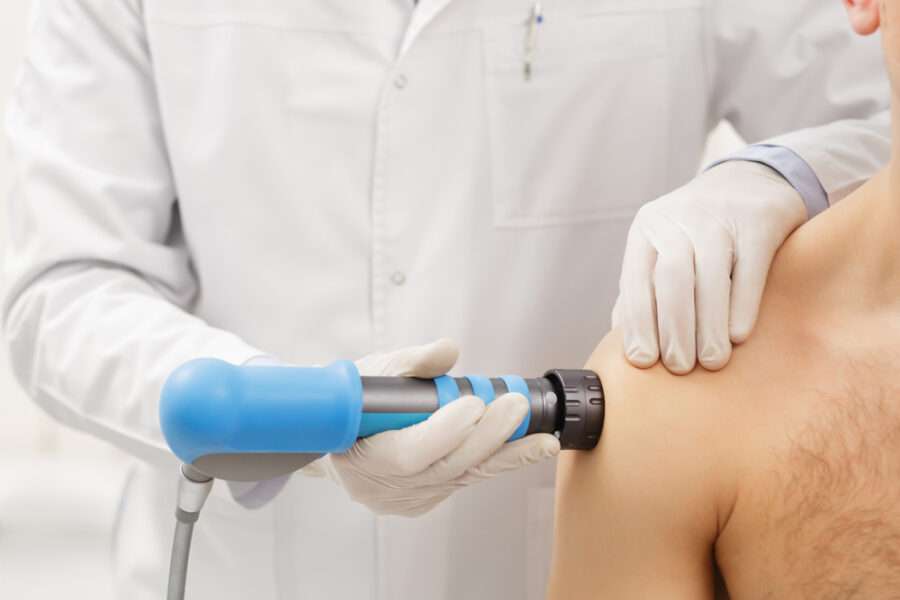
ShockWave therapy, also called ShockWave, is a non-invasive treatment that uses high-energy acoustic waves to treat musculoskeletal disorders and sports injuries. It is a care option that chiropractors can offer to patients whose pain persists despite manual therapy treatments. Its principle is based on activating the body’s natural healing process, thereby helping to reduce pain and inflammation.
How does ShockWave therapy work?
ShockWave therapy consists of applying a device directly to the affected area of the body, where it emits acoustic waves that penetrate under the skin at a depth of 3 to 4 cm. These waves create percussions which, when reaching damaged tissues, cause microtraumas, triggering a healing response from the body.
In fact, the microtraumas precisely and controlledly induced by these impacts lead to increased collagen production and the formation of new blood vessels. By stimulating the body’s healing process in this way, ShockWave therapy accelerates the regeneration of damaged tissues.
ShockWave therapy is highly effective for treating chronic conditions resistant to conservative treatments, as well as calcific tendinopathies. It is also appreciated for the absence of significant side effects, the speed of treatment, and the minimal recovery time.
Conditions treatable with ShockWave therapy
In chiropractic care, ShockWave therapy is considered when pain persists and the body does not heal as expected despite treatments.
This solution can treat many conditions causing inflammation of soft tissues such as tendons and ligaments. That is why it may be offered to patients suffering from Achilles tendon tendinopathy, a condition that causes stiffness and pain in the tendon at the back of the ankle. Similarly, ShockWave therapy is effective for treating knee tendinitis (patellar tendinopathy), felt under the kneecap and more pronounced during walking; shoulder tendinopathy, often related to repetitive movements causing tendon wear; or epicondylitis (sometimes called elbow tendinitis), which can affect the inside or outside of the elbow joint.
Finally, it can also be offered to patients living with plantar fasciitis, an inflammatory disorder affecting the plantar ligament and causing sharp pain under the foot and heel.
How long before improvement is felt?
A decrease in pain can be noticed within hours after the first session. However, on average, 3 to 6 treatments spaced 5 to 10 days apart are needed to significantly relieve pain and allow tissues to fully heal.
Who can receive ShockWave therapy?
Typically, patients who have experienced persistent pain for at least 6 months and whose condition does not seem to improve despite treatments can receive ShockWave therapy.
Besides this criterion, the chiropractor must assess the patient’s condition to determine eligibility. The health professional relies first on a medical interview, which includes analyzing previous treatment outcomes and reviewing the patient’s medical history (including surgeries and medications). A physical examination completes the evaluation, and imaging tests may be requested to confirm the chiropractor’s diagnosis.
It is important to emphasize that ShockWave therapy may be contraindicated for certain individuals. This includes patients who have recently suffered an injury, have a bleeding disorder, nerve or vascular lesions, cancer, or are undergoing long-term corticosteroid treatment. Pregnant women are also not eligible for this therapy.
What happens during a ShockWave therapy session?
Once the device is set up, the chiropractor applies gel to the treatment area to improve wave transmission. When the patient is settled and ready, the chiropractor then places the device on the skin and starts the treatment.
During wave emission, the patient may feel tingling, pressure, or even pain at the treated site. However, these sensations remain tolerable, and the patient is encouraged to communicate discomfort if they want the chiropractor to adjust the treatment intensity. The treatment is quick, lasting on average between 5 and 10 minutes; this duration may vary depending on the treated area.
Within hours following the treatment, discomfort may occur and is normal, but this effect usually subsides within about 24 hours. After treatment, it is important for the patient to follow the chiropractor’s recommendations, and although they can resume daily activities, they should temporarily stop sports activities. A personalized and progressive return-to-sport program may then be prescribed to ensure optimal healing conditions.
Chiropractic adjustments for optimal musculoskeletal health
In chiropractic clinics, patients receive natural care aimed at relieving pain related to dysfunction of the neuro-musculoskeletal system. The health professional most often uses manual therapy to restore neurological and joint function. However, complementary tools such as ShockWave therapy may also be used. In this same approach, other non-invasive treatment methods are employed, such as therapeutic laser, an effective technology that promotes tissue healing and aids in treating conditions affecting the spine and joints.